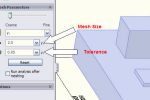
Mesh Tolerance Settings
Setting the standard mesh tolerance incorrectly can make some external features disappear. Meshing can fail on internal features.


Setting the standard mesh tolerance incorrectly can make some external features disappear. Meshing can fail on internal features.

Sometimes a multibody model refuses to mesh with the standard mesher. Regardless of the element size and tolerances used, some parts refuse to bond.
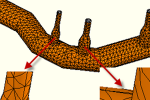
Surfaces can be challenging to create, but solids are easy to convert into surfaces. Surfaces originally created as solids do not have the problem of nodes not joining at edges
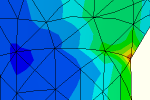
Surface models can be challenging to mesh. Parts that touch might not share nodes, preventing the correct transfer of loads. The resulting calculated stresses and displacements can be wrong.
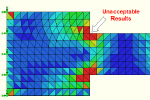
Stresses at sharp corners rise towards infinity as the mesh size is reduced. However the forces have to balance in a Finite Element model regardless of the mesh size used. In these studies SCL (Stress Classification Line) results are compared a different mesh sizes .
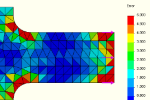
Error plots show how well the complexity of a mesh matches the complexity of the model. Once a match is made the reported error is low.
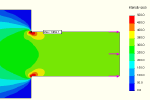
This report examines the accuracy of stress results near an area of discontinuity as the mesh is refined.
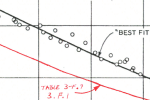
How do ASME permissible fatigue curves compare to actual fatigue life results? Can they be used to predict the expected life of equipment?

Finite Element Analysis (FEA) can usually be used to support pressure equipment design submissions where the configuration is not covered by the available rules in the ASME code. Requirements vary by province.

Two common areas of high error in a FEA report are under bolt heads and at surface to surface contacts. This article explains in more depth why this happens.
